Episode 81 - The reasons retention breaks in large organisations

Tom Burrell
January 08, 2026

Did someone forward this to you? If so, click to subscribe
Welcome to episode 81 of The Retention Blueprint.
As we start the year, the format of this newsletter has evolved: concise briefings here, with deeper frameworks and case studies available on the website.
As a result, it will arrive less frequently in the inbox, with more depth sitting on the website instead.
Let’s start with a foundational idea: retention is an ecosystem, not a (CRM) tactic.
Retention is an ecosystem (not a CRM tactic)
Most mid- and large-enterprise businesses still treat retention as a CRM problem.
The retention number sits with the CMO or CCO, the lever is assumed to be lifecycle marketing, and progress is measured through messaging performance.
What I see repeatedly is that once CRM execution reaches a certain level of maturity, retention performance plateaus.
This is because messaging is only one part of a much bigger ecosystem.
Retention is an outcome of how acquisition, product, value realisation, service, commercial mechanics, and lifecycle interact. CRM and lifecycle sit inside that ecosystem; they don’t define it.
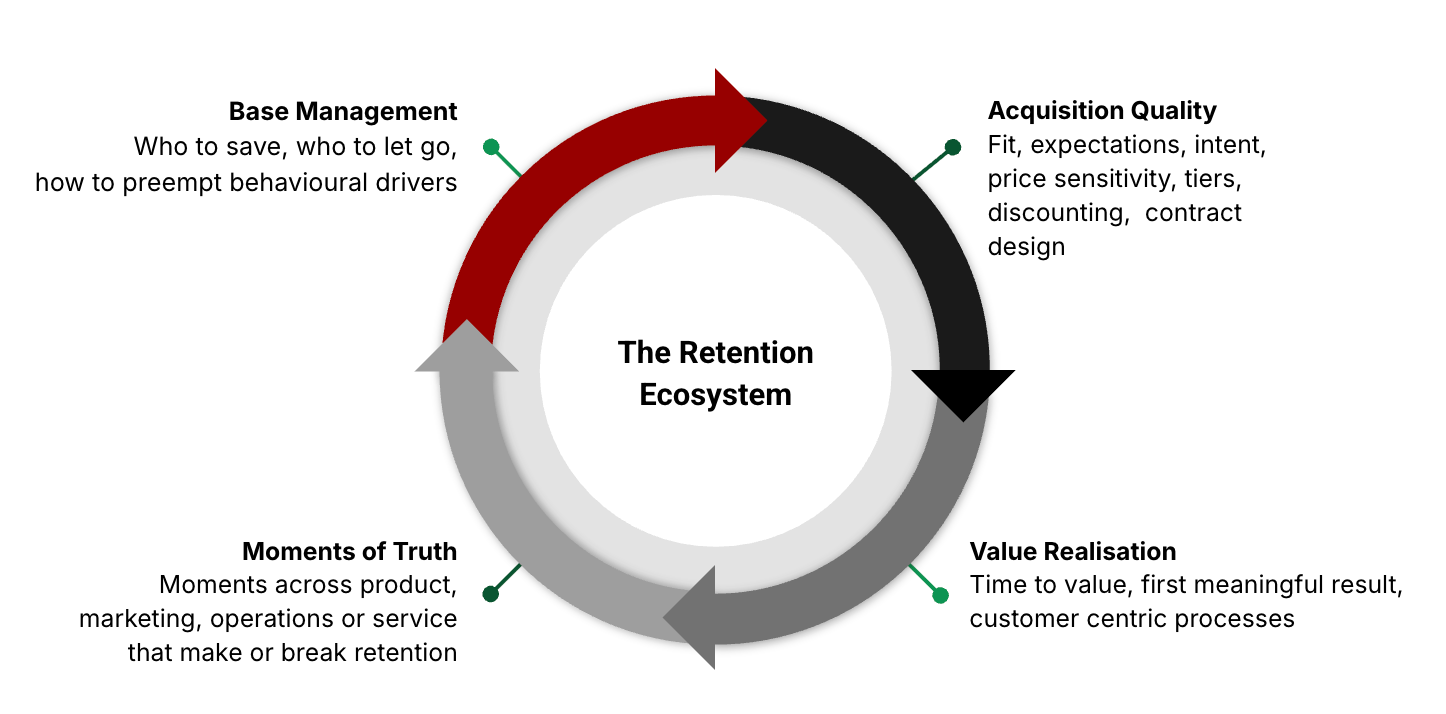
In practice, retention performance is usually constrained by a small number of system failures.
Acquisition quality sets the ceiling, who you acquire, how you price, the tiers you offer, and how commitment is designed, all shape downstream behaviour.
Early-life and in-life churn are driven by different failures, but are often treated as the same problem.
Moments of Truth reveal where ownership breaks down across teams, and this is crucial because it is at these moments that trust (and retention) can be lost forever.
Behavioural drivers, not a lack of messaging, explain most churn, which is why intelligent base management matters far more than volume of messages.
The complicating factor is organisational reality.
One ExCo leader owns the retention KPI, but the levers that move it sit across multiple functions, each optimised to different incentives and success metrics.
This framework is designed to help senior leaders diagnose where retention is actually breaking before deciding what to fix and to help leaders realign teams around the priorities that matter most.
T-Mobile Case Study
A clear example of retention treated as an ecosystem rather than a tactic is the transformation of T-Mobile USA.
Facing intense competition and a poor reputation, T-Mobile didn’t attempt to “fix retention” through messaging or promotions, it made coordinated changes across the ecosystem.
Acquisition shifted toward value rather than volume, with simpler plans, transparent pricing, and flexible commitment options.
Value realisation was accelerated through family plans, bundled services, and easier upgrades.
Moments of Truth were redesigned, particularly in service, with expert-led teams empowered to resolve issues in a single interaction.
The result was not just improved retention, but improved acquisition efficiency, higher upsell, lower cost-to-serve, industry-leading shareholder returns and a tripling of the customer base.
If retention is a current priority and progress feels harder than it should, this is the type of system-level work I help senior teams with. Reply to this message or click here to learn more.
Until next time,
Tom
P.S. What did you think of this episode? |
P.P.S If you know someone who would find this helpful, feel free to forward it.
Reply