Framework 2: Base Management & Lifecycle + Duolingo Case Study

Tom Burrell
January 16, 2026

Base Management = Commercial Mechanics + Behavioural Drivers
🧠 What this is:
A practical framework for designing base management strategies that integrate commercial mechanics, behavioural drivers, and lifecycle execution to protect and grow recurring revenue. Without addressing behavioural drivers, commercial optimisation will simply erode margin.
👤 Who it’s for:
Enterprise leaders carrying the retention number, CCOs, CMOs, and commercial heads, with cross-functional pressure.
📈 What it does:
Shows where and how to intervene in the existing customer base to reduce churn, stabilise usage, and unlock profitable growth leveraging behavioural drivers.
Executive Summary
I’m on record as saying that CRM marketing does not define retention. It sits inside a much broader ecosystem.
Retention is the outcome of how acquisition, product, value realisation, service, commercial mechanics, and CRM / lifecycle interact.
CRM & lifecycle marketing give you leverage inside that system, but they do not determine retention.
That said, one of the most powerful levers in the retention ecosystem is effective base management, and CRM & lifecycle marketing play a key role because messaging creates opportunities to drive proximity.
In this framework, we explore how to build an effective base management strategy that accounts for both commercial mechanics and common behavioural drivers of retention/churn.
But first, what happens if you do have a base management plan
This is best explained with a hypothetical scenario…
At the start of the year, you have 100% of your customers. You expect to lose 10pp and budget for 10pp customer growth to reach 110% of the previous year's customer base. The 'plan' bar in the graphic below:
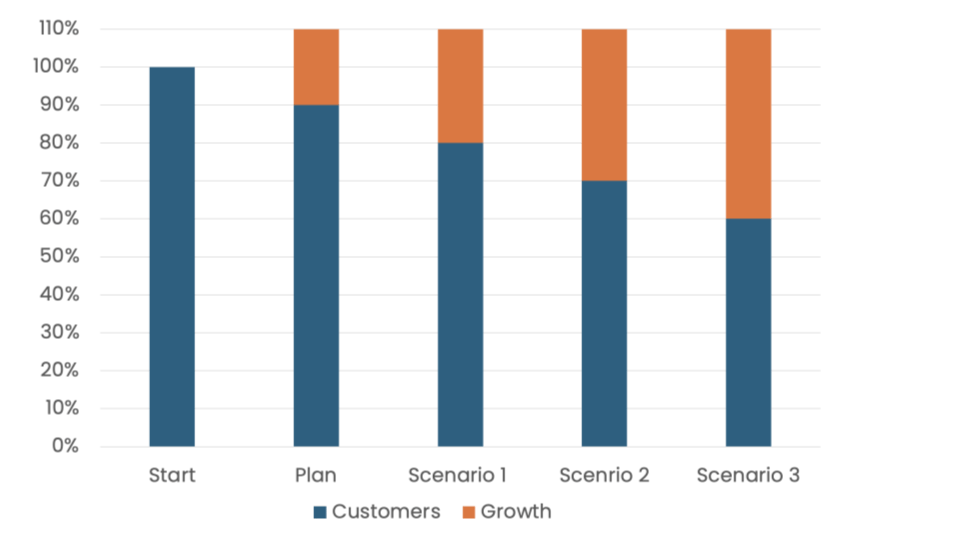
Consider three scenarios where you miss your retention targets.
Scenario 1: You missed the retention targets by 10 percentage points. This means that to reach the 110% customer base target, the acquisition target must increase by 50% (from 20 percentage points to 30 percentage points).
Scenario 2: You missed the retention targets by 20 percentage points. This means that to reach the 110% customer base target, the acquisition target must double, from 20 percentage points to 40 percentage points.
Scenario 3: You missed the retention targets by 30 percentage points. This means that to achieve your overall 110% target, your acquisition target must increase by 250% (from 20pp to 50pp).
In any of these scenarios, you will need an increased acquisition budget, which will reduce profit, or you will need to accept lower growth or worse.
In simple terms, an effective base management strategy:
Maximises profit protection
Maximises the opportunity for profit growth without putting undue pressure on acquisition
Allows for cost optimisation/reduction because exceeding your retention target can allow for lower acquisition spend
There are two aspects to base management.
The first aspect is commercial mechanics: how do you decide what price point to offer to whom?
From a customer perspective, this is typically experienced as a proactive midlife, renewal, or cancellation-stage activity.
The second aspect concerns how you mitigate standard behavioural drivers of defection before they become retention issues.
Commercial Mechanics
Commercial mechanics are crucial for base management.
Pricing, tiers, discounting, contract lengths, and renewal mechanics all actively shape retention outcomes.
The key is to focus on Customer Lifetime Value (CLV).
CLV is a forward-looking, predictive metric that represents the present value of future cash flows attributable to your existing customer base.
It includes:
Historic customer level margin
Predicted additional tenure and margin
Predicted upsell/cross-sell propensity and margin
Historic and predicted referral impact margin
Plus a discount factor to bring the past and future value of money to the present value
Ultimately, your goal is to optimise commercial outcomes over a predefined period (e.g., 24 months) by understanding the likelihood of churn and tenure at the current price/tier versus the probability of retention and extended tenure at X price/Y tier. X and Y are your offer.
With an accurate CLV model and cohort-specific retention predictions (churn propensity + survival curves), you can build an offer strategy for existing customers that locks in revenue.
For example:
Higher predicted future CLV monthly flex customers can be offered deeper discounts to stay if they initiate a cancellation.
Engaged monthly flex customers can be offered fixed-term contracts to lock in revenue. Survival curve analysis can help identify cohorts with this profile that also have an expected tenure below the fixed term to ensure no cannibalisation.
High-propensity-to-cancel fixed-term contract customers can be offered mid-term recontracting options, such as a slight price increase or a flat rate to extend their commitment. Even a discount vs the current monthly amount can make commercial sense over 24 months, depending on the accuracy of the churn model, the likelihood of churn, and the customer's contract stage.
The key is to leverage the following dynamics to create a commercial offer strategy that maximises profits over a predefined period (e.g. 24 months):
Total CLV (historic + future)
Predicted future CLV
Contract type (e.g. monthly, 12-month etc.)
Tier/bundle
Tenure stage, e.g. month 8 of a 12-month contract
Ultimately, you will be left with multiple scenarios and associated promotional pricing/options, and strategies, driven by data-driven hypotheses based on past customer actions and behaviour.
From here, you build a base management testing strategy leveraging commercial dynamics that are both valuable to the customer and drive incremental revenue over a predefined period (e.g., 12 or 24 months).
This is something leading telecommunications brands do really well, sometimes with 100+ cohorts, each with associated commercial mechanics based on customers' profit/tenure dynamics and lifecycle triggers.
Behavioural Drivers
Four behavioural drivers appear repeatedly across subscription and recurring-revenue verticals, to varying degrees.
These are:
1. “I don’t feel the value fast enough to keep using this.” If the customer's job is not solved quickly and relatively effortlessly, they may never fully engage. This is particularly true for B2B SaaS, streaming, meal kits, and similar categories.
2. “I’m paying for something I don’t use; I feel guilty.” All subscriptions are charged on a recurrent basis. Gyms, Netflix, meal kits, vitamins, meditation apps, gaming passes, and premium newsletters all follow the same pattern: when usage drops, guilt rises, and churn becomes inevitable.
3. “The novelty has worn off, I’m not excited anymore.” Human brains love novelty, but we also habituate quickly. Streaming libraries, fitness content, subscription boxes, betting apps, mobile games, learning tools and meal kits all often experience novelty fade.
4. “I don't feel valued.” Human beings wanted to be treated like humans, not a statistic, this means feeling like their custom is valued.
So effective base management is not just about your commercial offer strategy, it’s also about:
Early life value realisation
Maintaining usage to avoid guilt
Maintaining novelty/freshness
Ensuring the customer feels valued and appreciated
Early Life
When there is an intention-action gap in early life, it can be a huge driver of churn among monthly customers and of inertia churn among contracted customers, leading them to leave quietly at the end of the term.
Intention does not equal action. Customers may want your product, believe in its promise, and still disengage if they don't feel value quickly and with minimal effort.
Key success factors in early life include:
Recognising that the customer is still evaluating you. Until the subscription stabilises (typically post 90 days, but easily identifiable via your retention decay curves), it is absolutely critical to remember that the customer is still evaluating whether you (a) are a fit for their needs and (b) live up to the acquisition marketing. This means reselling the product's benefits through your onboarding lifecycle programs and quickly delivering a tangible result for the customer.
Recognising that it is not the product or service itself that matters, it’s the value the customer derives from the solution. You want strong value realisation, as this will create an emotional bond.
If you get a subscriber to do something with you regularly in the first 90 days, it will significantly increase the likelihood that engagement with your brand becomes a habit. One way to sustain usage over the first 90 days is to gamify it by identifying the behaviours that retained customers undertook in early life and encouraging new customers to undertake those actions.
Upselling in onboarding may seem counterintuitive and overly aggressive. Still, the reality is an upsell offer in an onboarding program typically means that either (a) the customer sees more value in the existing subscription since they got a ‘good deal’ at a lower cost, if they reject the upsell or (b) the subscriber is more committed to the outcome and stays longer if they take the upsell.
If your customers are not engaging in early life, they have a high propensity to churn. In these instances, do not be afraid to increase the frequency of CRM Marketing messages, expand the channels used, or increase messages from your product or service teams.
But ultimately, base management in early life is not about volume of communication. It’s about guiding customers to the specific actions that retained customers reliably take and removing friction that slows them down.
I wrote more about early life retention strategies here.
Maintaining Usage
In some industries (streaming, meal kits, subscription apps, gambling, fitness etc), usage decline is the most reliable leading indicator of churn. As usage drops, guilt rises. Customers don’t cancel immediately; they emotionally disengage first. Cancellation becomes the act that resolves discomfort.
Effective base management detects usage decay early and intervenes promptly, typically through relevant, highly personalised lifecycle and CRM marketing or product interventions.
But the key to maintaining usage is to ensure it does not drop at all; this can be achieved through highly personalised consumption recommendations and gamification techniques. A Duolingo case study follows below.
Maintaining Novelty/freshness
Novelty decay is inevitable. Human brains habituate quickly. Products don’t stop working; customers stop being excited by them.
Novelty fade becomes dangerous when no one owns it. It often sits between product and marketing, and the key is to ensure a smooth transfer of information between both functions so new capabilities, content, and features are communicated to relevant cohorts as they become available.
Base management must actively:
Re-surface underused features
Encourage exploration
Refresh the perceived value of the offer over time through new content, features and launches
Netflix are exceptional at this. They use their vast datasets on customer behaviour to inform decisions on content production and acquisition, and to promote the relevant new content to the right audiences in product and CRM/lifecycle Marketing. Then, when something will make a really meaningful retention difference for a substantial portion of the customer base, they do big above-the-line launch initiatives (like the recent Stranger Things Season 5 launch). What is key is that these above-the-line launches are primarily implemented to drive retention, although they also support acquisition.
Ensuring the customer feels valued
Feeling undervalued is sometimes about price, but often it's about recognition.
I write a lot about moments of truth (here, for example), mid-contract price changes (even if communicated upfront), making downgrades or pauses difficult, and poor service interactions can all be powerful moments of truth that lead to defection.
This is because all of these initiatives create a sense that the customer is not valued.
However, in the context of base management, ensuring your customers feel valued is not about optimising moments of truth; it's about explicitly recognising the contribution customers make to the business.
Initiatives such as:
Tenure-based recognition
Loyalty mechanics that feel earned
Prioritised service for long tenure customers
Covert offers that are at least comparable with new acquisition deals
A great example of a brand that did this well was Orange. They instigated prioritised service differentiation based on customer value and even ran a rate plan health check program, in which customers who were consistently using fewer minutes, texts, or data than included in their plan were offered the option to downgrade to a lower plan mid-contract in exchange for a contract renewal.
This had 3 positive effects (1) The customer felt appreciated, (2) 24-month revenue actually increased, because of lower churn, and (3) Third contract renewal rates also increased.
Of course, loyalty mechanics have a big role to play here, too. Loyalty programs typically have two objectives: first, to grow customer value among customers with potential to be upsold; and second, to reward existing customers, particularly the highest-value cohorts.
Feeling valued is a major driver of retention, and when it’s done well, it can also be a major driver of referrals. I wrote about referrals here.
How to use this framework
Use this framework when retention is being discussed tactically, but the commercial outcome isn’t improving.
It is most valuable when CRM activity exists, but churn persists because pricing, contracts, value realisation, behaviour and CRM / lifecycle are not holistically integrated.
Use it to replace CRM-only thinking with a system-level view of retention.
This framework replaces the assumption that better messaging fixes churn, and instead forces alignment across commercial mechanics, behavioural drivers, lifecycle stage, customer value and messaging (better messaging helps too).
Use this framework to avoid the common failure mode: over-optimising offers without fixing behaviour. Teams often jump to discounts, save offers, or contract changes without addressing early-life value, usage decay, novelty fade, or feelings of being undervalued. This often leads to unnecessary margin reductions.
Case Study: Duolingo
Duolingo is one of the best examples of behavioural retention done well. They focus heavily on early-life value realisation, 30-90 habit formation, and maintaining usage via gamification. Duolingo doesn’t rely on discounts. It engineers behaviour first by using CRM marketing, lifecycle and product together to drive streaks, guilt avoidance, and momentum.
1. Early-life value realisation
Duolingo is ruthless about collapsing time-to-first-meaningful-success (day 1-7). They use very specific mechanics for this:
Instant competence loop: The first lesson can be completed in under 60 seconds, with visible progress (XP, level completion, streak start)
No blank-slate anxiety: Users never face “where do I start?” — the path is pre-selected and linear at the beginning.
Immediate feedback: Every answer gets instant validation or correction, reinforcing “I’m learning” rather than “I’m studying.”
Progress visibility: Skill bars fill quickly in early lessons, creating the perception of momentum.
This is because perceived progress matters more than actual progress at this critical time.
2. Habit formation within 30–90 days
How Duolingo turns usage into identity. Very specific mechanics:
Streaks as identity, not reward: The streak isn’t framed as a bonus; it’s framed as who you are now (“You’re on a 17-day streak”).
Loss aversion over gain: Notifications are worded to prevent loss (“Don’t lose your streak”) rather than promise reward.
Temporal anchoring: Daily reminders arrive at roughly the same time each day, reinforcing habit loops rather than ad-hoc engagement.
People protect their identities more fiercely than they do benefits, and that is the real behavioural retention mechanic at play here.
3. Usage maintenance via gamification (without novelty decay)
How Duolingo avoids the “gamification wears off” trap
Duolingo’s gamification works because it’s layered:
Very specific mechanics:
XP is a numerical score users earn for completing lessons, maintaining streaks, and hitting daily goals. This makes progress visible after every session (even short ones), it reinforces completion (I did something) and creates momentum.
XP is relative, not absolute: Leaderboards reset weekly, so competition always feels winnable.
Leagues create social pressure without social graphs: You compete against strangers, avoiding the downside of real-world embarrassment while keeping accountability.
Variable reinforcement: Bonus XP windows, double XP, and surprise rewards introduce controlled unpredictability.
Progression ceilings: Higher leagues increase difficulty, preventing “I’ve beaten the game” syndrome.
Duolingo’s retention strategy isn’t “CRM-led” or “product-led”, it’s orchestrated and integrated. Duolingo is a textbook example of Moments of Truth orchestration.
Very specific mechanics:
CRM triggers behavioural moments: Push/email is tied to missed routines, streak risk, or league position, not calendar schedules.
Product fulfils the promise immediately: Click-through always lands the user inside the exact lesson or action that resolves the tension.
Message tone mirrors emotional state: Gentle nudges early, guilt-avoidance mid-streak, encouragement after lapses.
No discount crutches: Promotions are rare; behaviour change does the heavy lifting.
📩 Ready to see what this looks like inside your org?
I run a Retention Prioritisation Sprint for senior teams who carry the number.
Independent retention diagnostic
Clear prioritisation logic
Board-defensible executional plans
→ I work with one client at a time.
→ If retention is high-stakes for you this quarter, book a strategy call or email me [email protected]
Thanks for reading,
Tom
P.S. What did you think of this episode? |
P.P.S If you know someone who would find this helpful, feel free to forward the link.
Reply